Wednesday, July 28, 2010

Shuttle Espresso Machine Review

Introduction

Domestic e61 heat exchanger machines have been on the market for quite some time now and for all of that time, they have been quite expensive. Lately, with the rise and rise of specialty coffee, we have seen an increased interest in these machines, part of which has coincided with an increase in prices of these machines as a consequence of the Australian dollar's fluctuation against the Euro. All of this has created a climate where there is a business case for sourcing out decent machines made in a country with a lower cost of labour and a more favourable exchange rate and bringing in a pricing model where the importer sells direct -as opposed to adding a markup to support a reseller network - in order to deliver a cheaper machine to the consumer. This is exactly what e61 has done in bringing the Shuttle into Australia from China. Of course, whilst this might be a recipe to cry "knock-off", none of these things
actually gives any indication as to the quality of the machine and the coffee that it creates. For this reason, I was interested and grateful to Matt from e61 to be given the opportunity to explore the machine.

This review is written with people who might be interested in buying this machine in mind. This means that I will make reference to other domestic espresso machines that I have used and even a few commercial machines. These references will be comparisons to tease out a little more about the Shuttle, seeing as this machine falls to be evaluated against a market of competing products, but are not intended to give any sort of insight into those other machines.

Finally, I want to touch on the issue of reviewer independence in this review. To Matt's credit, from the outset he accepted that I am only interested in writing this as a totally independent review and that I might not have anything nice to say about the machine. I have sent Matt a copy of the text of this review in advance so that he could comment on it; that resulted in one amendment, which was to correct my original error in saying that the machine was manufactured in Taiwan and not China. Our arrangement was basically this: I get to use the machine free of charge to me, but get nothing else. I cover all costs of coffee.

Espresso

Espresso is the most difficult part to get right in any espresso machine. If I were in the market for an espresso machine, I would give the most weight to this part and little weight to the rest of it.

Espresso - Taste Test

To evaluate the machine, I tasted a few different coffees that I am fairly familiar with.

The first was a commercial espresso blend comprising Ethiopian Yirgacheffe, Kenyan and central american coffees at a medium to light roast level. This is a fairly difficult blend to work with, but is capable of delicious results. I chose this blend because the result in the cup would give me the most information about how the machine was functioning. The espresso was thin, sour, metallic and dominated by grapefruit flavours (presumably from the Kenyan component) at all dose levels, with the contribution from the yirgacheffe overwhelmed.

The second that I chose was a commercial espresso blend that was slanted more towards heavy body and chocolatey sugar browning flavours. I chose this because it is a coffee that has proven itself to have mass appeal. The espresso was a little bitterer and ashier than I expected, even at coarse grinds, high doses and fairly fast flow rates. The coffee also seemed to blonde out towards the end of the pour (but I note that this is something that I have noticed with a lot of domestic espresso machines).

I tried a few other coffees and struck gold with some home roast Tanzania Blackburn Estate Shade of September Microlot. This was a failed filter roast that went slightly too far. Too light for most espresso machines, on the Shuttle it produced a sweet, rich shot with loads of berry goodness and a lively acidity. The fact that this coffee performed well illustrates a good point about domestic espresso machines and most commercial espresso machines; seeing as people don’t tweak brew temperatures, people will tend to gravitate to blends that suit their machines, which is always a consideration to take into account when reading reviews and posts online.

These taste tests, together with the steam flashing from the group, made me suspect that the machine was running too hot.

Espresso - Numbers

I borrowed a Scace device and portafilter pressure gauge from Craig at 9 Bar Espresso Services in order to test out the machine. The first thing that I did when the machine arrived was to run the pressure gauge and see it settle at around 9 bar brew pressure. I used the brew pressure gauge before packing the machine up and got a reading of 11 bar. I should note that this was using a blind gauge.


The Scace device read brew temperatures between 104C and 99C. For reference, the Giotto at work put out brew temperatures between 94C and 89C.


Temperature measurements should be taken with a grain of salt, in that there are a myriad of factors that can give rise to inaccuracies. The Scace device does a fantastic job in creating a platform for repeatable measurements, but it is still important to be aware of sources of error, such as probe and multimeter error. In this case, the actual value of the reading may be out by a few degrees. For what it's worth, boiling water read 104C on the particular multimeter that I was using, which implies that the “true” brew temperatures were in the range of 100C to 95C. As an aside, the difficulty in measuring brew temperatures is something that people should consider when reading espresso machine reviews that give a passing reference to “temperature stability” or similar without giving any insight into their measurement process. Similarly, brew pressure measurements need to be taken with a grain of salt, as measurements taken from the gauge built in to the machine will vary depending on where the gauge sits in the internal plumbing on the machine - so two different models displaying the same brew pressure on the internal gauge might actually have different brew pressures when measured at the head. Measurements at the group head depend a little bit on the measurement device; I seem to remember that the rule of thumb is to subtract about one bar from the gauge reading for blind gauges.

In terms of how these numbers scrub up, I think that we can infer fairly safely that the brew temperature is on the high side. I should note that there is no "correct" brew temperature; most espresso blends will perform well somewhere between about 89 and 96C, depending on roast levels. I'm a little more hesitant to draw conclusions about brew pressure; I think that this is not a variable that has been well explored, seeing as most machines are set at the "holy grail" pressure of 9 bar ... using whatever gauge is most handy! That said, I suspect that lower brew pressures might be a little more forgiving for the domestic e61 HX market.

Milk - Use

In contrast to espresso, milk performance is fairly straightforward and easy to evaluate. To test out the milk, I tried frothing on a few 350mL jugs in a row. There was certainly enough steam available, such that I actually found it a little difficult to control. My housemate, a professional barista, thought that the steam was great, which suggests that it might just be a matter of spending the time to get the right
technique.


I did notice that the "no-burn" steam wand got uncomfortably hot after steaming a few jugs in a row. This is consistent with the performance of other steam wands with inserts that I have used on domestic machines, such as the Giotto that I have at work.

Milk - Numbers

The Shuttle was able to steam enough milk for a single milk drink, using a 350mL jug, in 16 seconds. In comparison, the Makin Espresso Maver machine also takes 16 seconds and the Giotto that I have at work takes about 26 seconds. A La Marzocco FB-80 can do it in 10.

In my review of the Makin Espresso Maver machine, I noticed that a good predictor of steam performance is the amount of time that it takes for the steam boiler to drop to 0.7bar, seeing as at this boiler pressure the milk isn't being moved around enough to be worthwhile. When the steam valve is fully opened, the Shuttle drops to 0.7 bar boiler pressure after 33 seconds. In contrast, the Makin Espresso took 85 seconds last time I checked and the Giotto at work takes about 28 seconds.

The Machine

This section is just some brief notes on the build aspects of the the machine.

The Good:

Stainess steel frame - won't rust as compared with a powdercoat steel frame, which can rust where the powdercoat chips off. That said, I have to note that the courier dropped the machine that I used and as a result the section of the frame holding the drip tray had bent.

Stainless steel tank - makes sense, given concerns over the past few years of materials leeching from plastic. The tank has a valve fitted to the bottom so that it can be pulled out, filled and dropped back in, though the over pressure hose must be maneuvered back into place.


Wire grill over drip tray - you don't get as much crap collecting on the top of it and transferring to the bottom of the cup. Of course, the tradeoff for this is that you can see more of the muck that collects in
the drip tray. The opposite extreme is the metal plate drip tray cover of the giotto; see the photo below to see how much mess collects on top of it after a few shots. At work, I have to wipe the drip tray after
every use.


Internal components - whilst the machine is made in China, the components all seem to be components that have been used in other machines. The brain box is from gicar and the pressurestat is from CEME. I note, though, that I didn’t get to strip the machine down - instead, this is based on the tear-down photos sent to me by Chris.

Stainless steel body - seemed to polish up very easily.


Boiler is insulated - presumably a good thing in terms of energy savings, but query whether in this instance it isn't another factor making the machine run hot. Nonetheless, having the machine come with a boiler insulated from the factory means that there shouldn’t be any need to consider embarking on this task yourself.

The Bad:

Double portafilter spouts - these sit forward and, so, make it impossible to wedge the portafilter against the bench for tamping; they are also a little wide for pouring two both streams of a double shot into a single espresso cup. The Giotto has the same issue. See photo below.


Drip tray - the drip tray is far too small, particularly if you want to flush a large amount of water through it - I was emptying every shot or two, which is basically totally impractical unless you have your machine right next to the sink, in which case it is still annoying. I keep a bucket under the bench to empty the giotto drip tray into.

Water tank cover - the water tank cover has two holes punched into it for handles. Things like dust, dirt and ground coffee can fall through these holes. Again, the giotto has the same problem.

Stainless steel tank - the fit and finish on this was somewhat poor, in that some of the edges were fairly sharp. To my mind, this is a bit of a problem on the part of the machine that your fingers are going to get near the most often.


Drip tray grate - as great as it was to see a wire drip tray grate, it was irritating that the drip tray grate did not sit flat in the drip tray.


No brew pressure gauge.

Boiler pressure gauge - I found it somewhat hard to read, as the markings are not at the numbers that I am used to; eg 0.9 bar instead of 0.1 bar.

Conclusion

As I flagged before, for me an espresso machine purchasing decision should come down to espresso performance. In this case, I can’t honestly say that I was thrilled with most of the espresso produced by the machine. It may be that this is simply due to the machine running too hot, which is something that can be cured in a number of ways. I understand that E61 has requested modifications to the machine to address this problem. If these work, this machine might be worth revisiting as a good value
proposition.

Labels:

Monday, April 27, 2009

USA Trip 09 - Days 9 Through Whatever ...

New York


So after Coffeelab I didn't do too much coffee stuff in New York. Apparently there's stuff there that you can do other than coffee.

I did make it down to Cafe Grumpy and 9th St Espresso. Grumpy delivered service true to its name and coffee true to its reputation. Everything seemed to be very driven by Ethiopian coffees; more stuff of the IMV Ilk. The espresso and clovers were pretty good, but I have to say that I found their in-your-face IMV type flavour to be rather unsatisfying after the balance of the espresso that Mane busted out on our last day at Coffeelab. Fantastic cappuccino at both Grumpy and 9th St, with Grumpy pulling off a rather amazing transmogrification as the berry flavour of their coffee gave way to dark choc in the last few sips. But what's with the milk? Coarse bubbles at both places.

SCAA + Atlanta

The Specialty Coffee Association of America Expo was always going to be jam packed ... add the World Barista Championships and it was a very, very, very packed few days ...

WBC


Team Australia in their run through time; Tim, Wolffy and JP. I really wanted to spend more time with team Aussie and more time watching the WBC, but had too much stuff to try to squeeze in at the expo. In fact, I only ended up watching one performance - Mike Philips from the USA (who I thought definitely had a winning performance). Tim's run through went well; his espresso tasted really sweet and I can't wait to stream his performance, already knowing full well that he will have done us proud.


Grinders provided by Espresso Parts. Tshirts provided by latteart.net.au.

The WBC espresso bar; fancy being able to get great coffee at a barista competition!

Labs

OK, so in a nutshell, I did four labs - two brewing labs and two farming labs. The farming labs were absolutely awesome, with some guys at the cutting edge taking us through all of the various processes and correlating the many goings on at the farm with the result in the cup. Money well spent.

Show Floor


Me using the new time machine. At least I think it was a time machine; every time I came near it I lost half an hour!

The machine that everyone was talking about. Utterly amazing. Brew pressure profiling via a new lever group. Critics correctly point out that brew pressure profiling via a lever is impractical in a busy bar operation. Except when you can record the pressure profile and play it back! There were also a bunch of other cool things, including SS portafilters and teflon coated steam wands. I'll go out on a limb and say that I reckon this prototype is the best machine on the planet at the moment.


You can get an idea of the front of the machine from the photos above.

LM are popular dudes. Every man and his dog gave them coffee.

So how did the coffee taste? Pretty amazing.

Labels: ,

Sunday, October 12, 2008

The Supremes

The company: Coffee Supreme.

The blend: Supreme.

Following discussions about Coffee Supreme on the Melbourne Coffee Review facebook group, I decided to wander on down to supreme and pick up half a kilo of the supreme blend to try it out for myself. Back in the day, this blend was a light, clean and acidic blend with a relatively low body. I liked to think of it as being similar to Campos' superior blend and you can bet your bottom dollar that Campos would start sweating if Supreme decided to put supreme up against superior. (Supreme vs Superior ... seriously.)

Unfortunately, my enjoyment of this blend was interrupted by the palate training course that I did recently, so, with considerable irony, I apologise that my descriptions of this blend will be incomplete and based on recollection.

Drip/Siphon/Cupping: A classic cup; flawlessly clean, somewhat sweet, mild acidity, medium body.
Espresso: High in acidity, low in body when young, but improving after several days' rest.
Cappuccino: As expected, no presence in milk whatsoever at 3 days resting time, improving considerably at 7 days.

So there you have it. Not very useful, but it's something.

Supreme clearly put excellent coffee in the blend, but I think that a lot of people expect their espresso to be very high in body and very low in acidity. Here, Supreme demonstrates why a company has multiple offerings - try their FTO blend instead.


A clean cup in a dirty world.

As a quick addendum, I got to have the briefest of plays with a new WBC spec NS Aurelia. As with the other NS machines, the steam lever is totally awesome. Beyond that, I think what my tastebuds and my thermocouple readings told me are best summarised by the following photo:

Labels: , ,

Thursday, August 28, 2008

The Emerald in the Coffeebloggosphere's Crown, or not so Special?

Eliminating The Suspense

Esmeralda = emerald in Spanish, OK?

The Esmeralda That Was


Esmeralda is one of the coffees widely regarded as one of the world's best; its reputation is that of a modern-day Jamaican Blue Mountain. Last year, my curiosity got the better of me and I arranged to procure some from Paradise Roasters. In blogging about it, I introduced it as follows:

I probably don't need to write too much about this one. If you have been living under a rock, or if you just happen to be one of the few people who doesn't follow the coffee auctions, you might not know that this is currently the world's most expensive coffee. Previously, that dubious honour went to kopi luwak. (I'll spare you the jokes - google it if it's news to you.)

Esmeralda has an impressive back story; in a nutshell, the gesha varietal that makes up the Esmeralda Especial lot seems to have basically gone extinct except for a few random rediscoveries in Panama. It just so happens that this particular farm's gesha offering has won something like four Best of Panama auctions and every single other cupping competition it has been entered in. In terms of scores, the consensus seems to be that it's a 92 at a minimum, with some tasters going as high as 97!

The 2007 Paradise Roasters lot displayed a predominant and intense mandarin flavour in all brewing methods, backed with hints of bergamot and a slight astringency.

The Esmeralda That Is

Last year's, as far as I can tell, the correct name for it was "Hacienda Esmeralda Special." Flash forward a year and all of a sudden, the Petersons decided to shake things up by sorting the crop into different lots, all of which were auctioned under the "Hacienda Esmeralda Special" moniker. Again, the auction was blogged about widely. Readers are encouraged to post links to other relevant posts in the comments field. If you have to choose only one (other) blog post to read on the subject, remember the old saying - "in Hoff we trust." James' points about dilution of their own trademark and the effect on the market struck a chord with me, particularly seeing as trade marks was one of my favourite subjects.

The auction itself always reads like a who's who, so you might like to imagine Joan Rivers delivering the commentary. Stumptown was wearing batch one, hailing from "north of the creek," but the heavy hitter shared the most expensive batch, two, with Sweet Maria's. The dashing duo deftly devoured batch three, the peaberries, whilst 49th snapped up the sole double pass lot. Though the Petersons didn't credit Mountain Top for their technique - as I understand it - one wonders if the Piccolo clan's decision to purchase wasn't influenced by best buddy, Australian Mountaintopophile and coffee guru, Instaurator, who has done some consulting for them. Batches six through ten were bought by a wide spectrum. For the readers of this blog who I know follow the Japanese CoE buying circuit, it looks like crowd favourite Kentaro Maruyama didn't even contest the Esmeralda auction against big dog Wataru Nishibayashi. Presumably this means that Wataru will edge ahead of Maruyama in the awesome coffee purchasing league tables, but I would still want a several Watarus for my mint condition Maruyama trading card.

Competition results also deserve a mention. This year, the Petersons gave the Best of Panama competition a miss, presumably in order to give someone else a chance at winning. They also failed to place first for the fourth time in a row at the SCAA cupping pavillion (perhaps one of my kind readers could provide the link; I can't seem to find it). Fortunately, though, they did at least manage to walk away with first place in the rain forest alliance cupping for quality competition.

Anyhoo, that's enough background.

Having had spectacular success with the Mamuto, I decided to place an order for Esmeralda with Terroir, along with a few other goodies for various people:


Nim's care package; two packs of Esmeralda, a pack of Mamuto, Coffee Trail book, Hacienda La Minita book and a pack of the AWESOME filtropa pourover filters to go with his filter cone.

Let's take a closer look at that label ...


Where's the trademark Howell photo?


It was interesting to note that last year's batch from Paradise was comprised of unusually long and thin beans. This year's lot from Terroir looked considerably shorter and rounder ... perhaps a consequence of the decision to separate Esmeralda Special into different lots.

Anyhoo ...

Siphon/Vac Pot/Clover: These brews varied from being excellent to OK and I found the coffee difficult to work with. Several tasters agreed that there were Earl Grey tea (bergamot) notes, but differed to the intensity that they perceived. Sweetness was not as high as I had hoped, there was a good measure of acidity and the coffee was dry. The best brews had hints of peach.

Espresso: As I felt that the coffee was slightly too dark for siphon, I took it into the big V, borrowed one of their grinders and treated everyone to some Esmeralda espresso. The espresso had the kind of astringency that I usually associate with a roast that is slightly too light for espresso, but displayed a tiny amount of sweetness and some tannic tea type flavours.

This lot was interesting, but not the mind-blowing experience of last year's lot. Differences could have been due to (a) the separation of the Esmeralda Special lots this year, (b) the roasting of the coffee and (c) the shipping of this coffee, and attendant two week delay from roasting, compared with the last lot being brought over in carry on luggage. It would be very interesting to try out the various lots from the various sources that bought them, but that would probably end up being an expense to rival Krusty the clown's addiction to faberge' eggs.

The Esmeralda that will be ...?

It will be interesting to see if anyone actually does the work of tasting all of the various Esmeralda lots and working out how big the spread in quality is. Who knows how Esmeralda Special will be divided up in future? I am also very interested to find out how 49th's lot will go and whether this processing method might take off in Panama.

Digression - Siphon - Again


Siphon continues to be a learning experience, though brews are usually pretty good nowadays. I thought that the butane burner warranted a quick post. Frankly, I can't see how you can really use a siphon without putting it on the stove or using a butane burner. I bought mine off ebay from Jack Grieve. A similar burner is available at a very reasonable price through Jack's web store, along with some pretty cheap siphons.

When used in conjunction with a thermocouple, the butane burner makes it possible to get repeatable and adjustable brew temperatures. A marathon session of three siphon brews (and three cleaning runs) showed that the burner seems to emit more heat immediately after it is filled with gas. Good practice would be for the first use after refilling to be in a cleaning run.

So far, adjustments to the water temperature, dose and grind for the siphon have had eerily similar effects to doing the same thing for espresso.

One final tip - remember that every siphon brew is diluted by the water that doesn't make it into the top chamber to start off with and, as this is a fixed amount, the proportion of each brew that is made up of water that has never been in contact with coffee will increase if you try to brew less than the maximum amount for any given siphon. This lead to the experiment and realisation that if the brew is slightly on the strong side, dilution with hot water can sometimes save it.

Labels: , , , ,

Sunday, August 24, 2008

Could it be ... BBB Logo ACF Tulips?

Move along.

Labels:

Sunday, October 21, 2007

Give The People What They Want: October Espresso Gear

OK, so I admit to being a tragic gear-head. That means that I always prick up my ears in October, what with many manufacturers debuting new stuff at the HOST convention in Milan. I'm sure that we'll get a deluge of reports, but I thought that I might get everyone in the mood with a quick overview of some relatively new stuff ...

Machines

Forget BHP shares, I wish that I had bought shares in words like "brew temperature" and "thermostability" - every man and his dog "knows" that you can only get a great espresso on a machine that can give you a rock-solid straight-line temperature profile that can be adjusted to 0.1 of a degree F. If you look around any manufacturer's or vendor's webpage you'll see that they all seem to be jumping on the bandwagon. Don't get me wrong; I change the temperature all the time on the FB80, but it does seem to me that people often lose sight of the basic goal - to get a coffee that tastes great. (Of course, if you put that claim to anyone the response is that it tastes the "best," the uninformed consumer gets a cup of whatever trade-show swill is on offer and the world keeps spinning ...)

From my perspective, the interesting thing is that the HX manufacturers seem to be pushing it a bit. After all, let's not forget that the original Faema E61 enabled people to run different and relatively consistent temperatures on different groups loooooong before Synesso did. The Brasilia Excelsior seems to be the machine that the Rossi group are pushing at the moment. It has an adjustable thermosyphon on each head. Last year there was a Brasilia machine with brew temp individually adjustable on each group head through a digital control panel floating around the roastery. I couldn't find it on the Brasilia webpage. The Elektra Kappa offers both adjustable brew temperature and, apparently, adjustable brew pressure through its front panel. Call me crazy, though, but I kind of don't see the point of having both steam wands on one side of the machine ;P Very interesting developments - but will the cool kids pay attention?

Well, if there's one thing that I love it's actually trying out new equipment. On Monday, Syd was kind enough to take some photos for us at Veneziano, after which we grabbed a bag of the same coffee that we had been drinking on the FB80, pulled by David Seng, and swung around to EES to run it through the GS3. Ben had only recently received the machine and was very accommodating, allowing us to basically pull shots on it for an hour to work out how it ticks. In a nutshell, we got the machine pulling some great shots. The ones that we finished up with had a bit less body than the FB80 shots, but had more complex flavours. Surprisingly, the GS3 seemed to produce more crema than the FB80. Fooling around with the various settings did produce notable changes ... exactly what you'd hope for.

So what's the dirt on the GS3? Chris Tacy famously put it that the GS3 takes the machine out of the equation, making it the barista's fault if anything went wrong. We found that to be true, except for two narrow circumstances that happened to represent the first part of our use. First, the machine seems not to like having the steam boiler temperature (and therefore the steam pressure) adjusted. The first thing that we did was to drop the steam pressure from 1.9 bar to 1.1 bar, which resulted in the subsequent shots tasting sour and the brew PID going out of whack. Presumably this had something to do with the fact that the brew water is preheated by the HX in the steam boiler. Setting the steam boiler back to 1.9 bar fixed the problem. Surprisingly, at that steam pressure steaming was still slow and restrained relative to the FB80. The second scenario in which we had to take the machine's needs into account was after refilling the reservoir, which also caused a temperature drop. After a few minutes, everything was back to normal. I didn't look at the PID, but perhaps the problem was that the elements switch off whilst re-filling. Other than that, there were a few niggling issues. This machine had the old water reservoir and guide holes for the drip tray that LM is replacing. Even after having worked on a Synesso I still find that style of steam wand a bit awkward, although the results were good. Besides, you buy an espresso machine to make espresso - most of them will steam acceptably.

Anyhoo, all up, I liked it a lot.

Photo courtesy of Syd:


Grinders
Proponents of grinder manufacturer Compak often say that their virtue is that they listen, whereas current king Mazzer sits aloof in its castle. As far as I can tell, Compak's big act of "listening" to pro baristi has been making a K10 without an auto-fill function and without the stupid tamper moulded on to the front. In other words, they made their star grinder more like the existing Mazzer Robur. (Not to knock Compak's product generally - the K10 is cheaper than the Robur and has been getting rave reviews.)

I guess that you do have to give something to the critics, though. If Mazzer really were a company that listened to its customers, surely we would have some sort of doserless Robur with a very accurate grind timer and built-in cooling fans.


... it just remains to be seen how it will perform. That said, I'd love one for home - it would be a great match for a GS/3.

Of course, I'm sure that Compak will also be showing off some new products at HOST. They seem to have dropped the A6 from their range and replaced it with the beefier A8. I suspect that they decided that the A6, being the same thing with 64mm flat burrs, was just too small and slow. Presumably we'll see an A10 version of the conical at some stage. The ability to select from grind on demand or grind one dose ahead seems pretty innovative. That said, they will have to do a better job of it than the single dose grind ahead grinder that I have used.

Tampers

I'll never forget Andrew pulling beautiful shots just by tamping with the palm of his hand. Coming from that perspective, it's sometimes difficult to take the hard work that tamper manufacturers put in seriously. Perhaps it's the backyard inventor nature of most tamper manufacturers that makes them prone to endlessly tweak their gear. I, for one, am very grateful that they all seem to seek feedback and, better still, act on it.

At the moment, I'm viewing new tampers as a race between the british dominions, with Mark Prince from Canada and Australian Greg Pullman both working on new designs. Greg's tamper is an attempt to make an ergonomic and durable design for commercial use. The prototypes that I have seen so far have definitely been a step in the right direction. Meanwhile, on the other side of the globe, coffeegeek Mark Prince has been working on his "precision" tamper, to be made by Reg Barber, for quite some time. Both Mark and Greg are keeping their products very hush-hush, but emails with both of them confirm that rumours of their demise have been greatly exaggerated ;P

Meanwhile, relative Australian unknown Steve Bailey has pipped them both to the post by very slightly tweaking his already very good tampers. Months ago, Steve whipped up a tamper for me with a third spacer ring for additional height. He of the large hands - Simon James - liked it so much that my tamper took several months break from my hot little hands to accompany him on the barista comp trail. Drop the laser-etched bottom, add a spacer ring, drop the price slightly and you have the new coffeelab tamper, photo courtesy of Syd:


... well, all up I'd probably suffer a robur electronic, a gs3 and a coffeelab on my bench, but I'm still very interested to find out if there's anything of note at HOST ...

Labels:

Wednesday, September 05, 2007

Request: Nuova Point Cups

Well, the Nuova Point cap cups proved to be a smash hit when I first bought them a few years ago. Today, they continue to be a smash. Literally! I'm down to one. I'd love to pick up a few more if anyone is buying a half dozen and doesn't want all of it. They're cheap as chips - only $30 for half a dozen, so if no-one is interested I might just buy some myself and be done with it.

Labels:

Saturday, February 24, 2007

New Setup

Not a hugely informative post; just to say that I'm building a bench for my espresso stuff. The knock box set into the bench has made it relatively easy to clean up, particularly as I have the grinder doser directly above it.

Labels:

Tuesday, January 16, 2007

Terra Keramik Cups

Yes, yes, I've been negligent of my blogging duties. Deal with it. More updates soon!

For the moment, I thought that I should begin by sending a shout-out to Reto at Terra Keramik. I first saw his cups on Mark's obscure coffee site a few months ago and thought that they looked kinda neat. One thing led to another, and before I knew it, Reto had sent a sample down to me to see whether or not cups function the same on the other side of the world. I figured that the least that I could do is blog about it.

Have you ever noticed that almost every US review of
coffee stuff talks about the packaging in nauseating detail?
This photo is dedicated to those reviewers ;P


The thing that got my attention was that Reto's marketing speak seems aimed towards high end espresso. Now there are heaps of cups out there that look cool, but they are either monstrously large or a bad shape for latte art. The Terra Keramik cups are hand-made, applying gorgeous glazes and platinum rims to the proven 5oz tulip shape.


Standard ACF tulip in the background for reference.

At times, the 5oz tulip seems like the holy grail of cups. Pun intended. The espresso to coffee ratio is just perfect. (Especially according to the Italians and the WBC!) In the domestic sphere, where equipment can be more difficult to work with, one can base their cappuccino on a double ristretto or even just cut a double espresso short. Pro baristi with less tempremental equipment can easily split a double espresso into two cups safe in the knowledge that the espresso flavour will not be overwhelmed with milk.

In terms of latte art, the tulip cups aren't bad, but the king will always be the bowl-shaped cup. The problem is that the 7oz really needs a double shot as a base ... or perhaps a shot and a half or something wierd like that.


Cassie works with me at First Pour.
I tend to avoid having pour-offs with her!


Given the inherent awesomeness of the 5oz tulip cup, I suppose that it was inevitable that everyone loved this cup when they first saw it. There were really only two niggling issues. First, the shape isn't as curved as the standard mass-produced tulip cups, which seems to make it more difficult to start pouring your rosetta. Second, the ceramic is quite thick, which is probably more of a reflection of what we're used to than anything else, but it does mean that the cup needs more time to heat up and takes more time to cool down.

Finally, I had a few little chips near the handle of the cup and some of the platinum seemed to rub off the saucer rim in the dishwasher, which is obviously rather irritating.

Now, as soon as Reto heard about this, he offered to replace the cup. Which is ludicrously generous considering that postage for a single cup costs almost as much as the cup. Plus I presume that it must take more time to package the cups than it takes to make them ;P In any case, these cups are premium products that command a premium price, so it's good to know that they come with the requisite level of support.

My verdict? I'm the sort of person who loves high-quality stuff with simple and clean designs, so I love my morning cappuccino in Reto's cup. Obviously the price is going to be an issue for many people - myself included - and the most anal of the anal would do well to re-read the pluses and minuses above. If the espresso cups are similar to the cappuccino cups, though, it's difficult to see what anyone could criticise about them. The glaze and rims are stunning, the volume seems to be perfect and the weight will be an advantage. Illy artistry meets Nuova Point practicality. I'd buy them before Illy, but, unless I get a few hundred in tips next time I pull a godshot, I don't think that that will be soon.


The stopwatch is in a standard NP demi.


Labels:

Tuesday, October 17, 2006

A shout-out

Massive kudos to Nim for getting me one of the ACF cappuccino cups from Justin and Marsha at Supreme. I've actually not yet made the trip to go meet those two - it's on the the "to do" list.


In other news, I'm entering the month-long exam prep time, so, unfortunately, my updates are going to be sporadic. Sorry to disappoint my avid fans. Both of you ;P

This weekend is going to feature two belated birthday dinners. At Toshi's recommendation, the guys on Saturday are getting Sihereni through Vac Pot. Sunday are getting Bundja.

Labels:

Friday, September 15, 2006

Some machines that I use ...

One of the reasons why I felt compelled to start up this blog is simply that I am lucky enough to be able to play around with an extraordinary variety of machines, each of which produces a relatively different cup. Seeing as I usually make reference to the coffee preparation conditions, I thought that I might take y'all, beloved readers, through this week's lineup to help put future coffee notes in context.


These are the machines that I will probably refer to most commonly in my posts. After all, they're at home! The Silvia is does the lion's share of the work at home. The combination of rancilio machines is, however, ruthlessly unforgiving.

To make it easier to nail the right temperature, I made a custom backsplash panel to hold a digital thermometer with the probe on top of the boiler. Seeing as QLD Mark showed that convection currents in the boiler only really stop about two minutes after the element light is off, my current technique involves adding more heat by flipping on the steam switch on for a few seconds if necessary immediately after the element goes off, then waiting until the values on the thermometer stop changing. For the mathematically inclined out there, I guess that that means that I'm technically looking at the derivative ... which makes me 1/3rd of a PID controller ;P I'm also using the stock La Marzocco double basket.

Shots from the Silvia and Rocky combo vary greatly in both quality and character. If one purges the wand a lot and starts starts steaming before the steam tstat switches the element off, it is possible to get more ample steam than most of the prosumer HXs that I have tried, but it is wetter.

The La Peppina is even more esoteric! It is a 1970s gravity-fed, spring lever machine. If you thought Rancilio's crappy thermostats were dodgy, be glad that your machine wasn't made by FE-AR; there is no attempt to control temperature whatsoever. You flick the switch on and the element turns on. That's all there is to it. Fortunately, with the lid off, temperature in the area where the brew water is sucked into the piston falls at a rate of about 0.1C/second, so it is possible to repeatedly get something like the temperature that you want. The lever also provides an interesting level of control ... I tend to let it pre-infuse the puck a little bit, then push the lever down to make sure that I've got a full single shot's worth of water flowing through. I can also increase the brew pressure by pushing the lever up to help the spring along. This machine provides great control over all aspects of brewing, but does require a bit of finesse.


Shots from the Peppina generally exhibit very clean flavours, tending towards the more acidic end of the spectrum, as opposed to the more chocolatey. The espresso can easily be thin in body unless you dose up and grind fine, and the crema always seems to fade to a few mm very quickly (unless you make a shot that tastes like garbage to optimise the crema). This machine is espresso only!


... so every now and then I go from my crappy home machines to what must be one of the best machines in the world. If espresso machines were knives, this would be a scalpel, whereas my home machines would be plastic picnic knives. If I were doing surgery, I know which I would choose! This machine derives its amazing flexibility from the multiple-boiler system. Each boiler is controlled by the PID underneat the drip tray ... which I should have cleaned out before taking this photo ;P Because of this, we are able to keep two groups dialled in for the house blend and use the third group to play around with whatever we happen to have around in our play grinder. The levers have a line pressure preinfusion position and a brew position. And you can turn them off, too, I guess.

Shots from the synesso exhibit amazing clarity of flavour and can be tweaked to get out pretty much any characteristics that your blend has. Sometimes, when we have time, we'll assault random enthusiastic customers with the same blend brewed at two different temperatures a few degrees apart ... they are invariably amazed by the difference. However, this machine gives you no room to hide with crap beans. If they are under roasted, they will taste sour and grassy. If they are over-roasted, they will taste charred and like vodka. If the blend has five great beans and one crap one, you'll taste the crap one. The Synesso steams like a train. At low pressures, the stock tip just doesn't cup it. The steam boiler is also PID controlled and we have it running at something like 1.4 bar! Slip up and you paint the walls!


The La Marzocco Linea is a classic. To my mind, only the e-61 is more iconic. The linea is the weapon of choice for many, many high-volume espresso bars across the world; and with good reason - they just won't die. This little trooper didn't miss a beat when we ran about 25kg through it at this year's Aroma Festival in Sydney. In about seven hours! That said, there's a tendency to deify Lineas. The truth is that the Linea has had a long production run. There are a lot of subtle differences between the different models; some are just OK, some are absolutely fantastic. One thing that springs to mind is the gicleurs. Gicleurs (or restrictors) are essentially a bit of metal with a hole through it. The hole determines how long it takes the machine to ramp up to full brew pressure. The smaller the diameter, the gentler the pressure rampup. The second obvious thing is the temperature control. As well as getting lineas at a relatively cheap price, Lineas come standard with PID in Australia. Dave Makin's Linea has 0.6mm gicleurs and does not have a PID.

Shots from the linea tend to be clean, with a relatively rich mouthfeel. Again, this thing has copious steam. Dave's linea exemplifies the adage that no matter how expensive the machine, a large part of its steaming capacity comes down to a $20 steam tip. I don't like the stock tip much, but swapping it with the Reneka Viva S tips makes it dead easy.


Although we all love the Linea, Veneziano is a roastery that supplies equipment. The vast majority of cafes out there aren't prepared to pony up the dough for a LM or a Synesso, and fair enough. Venez have had just about every HX machine under the sun go through, in a quest for something excellent and reasonably priced. I gather that Pete and Angelo often have to do a bit of internal tweaking to get the machines to perform how they want them to. So it's unsurprising that they have finally just gone and gotten a machine built to their specs so that, in future, they won't have to waste a lot of time tweaking it. This is the BFC machine that I mentioned a few posts ago. It is in the standard 'Diadema' case, which is somewhat poxy, but the internals are right. It's fun to have access to heaps of different machines!

Shots from this BFC machine are very rich and chocolatey, with all of the blend components mingling together to present one uniform flavour. It is understandable that this is what most cafe owners would want; consistency. You can use a blend with a bit of robusta in it to give you a bit more margin of error and you won't pick it up like you would on a Synesso. Nice. This, and the Dalla Corte machines, are my current favourite steamers. It is probably 100% down to the steam arm and tip, which I presume are stock parts used by both manufacturers. People who are ridiculously busy might want more steam. This can be cured with a $20 steam tip. (Sidebar; you wouldn't believe the amount of rebranding and identical parts used by different manufacturers - at least BFC acknowledge this and are happy to get the parts that you want.)


One of my first pours on the new BFC. Usually I screw up the first few jugs on a new machine!


Finally, we come to Dave's Maver machine. This is a little prosumer HX. Again, the thermosyphon has been balanced to require almost no cooling flush, which is a definite plus in my books. The drip tray is massive and the whole thing is made with what seems to be the same quality stainless that the ECM Giotto is made of. In fact, the story behind this machine really parallels the BFC machines - Dave visited Maver, told them what he wanted and they did it for him. Again, most manufacturers use the same parts ... expobar uses a non-e-61 group that has too much preinfusion time for my liking, but, other than that, I can't think of any majorly important differences in parts between most machines in this class. Having a machine like this at home certainly would be fun ... and infinitely preferable to a silvia!

Interestingly, the handful of shots that I have had from the Maver have tasted somewhere between shots from the Linea and shots from the BFC. There is some clarity and nuance, as well as some mega-chocolatey mouthfeel, but it's not like I have done a detailed comparison of all of the machines with the same blend - just my impression. What is really great, though, is that the machine is mega-forgiving. I pulled one shot with Primo that came out as a mega-ristretto and still tasted very clean and chocolatey. As you can imagine, steaming is a bit more anemic than all of the other 15+ litre steam boiler machines that I have mentioned, but no more so than with the other 'prosumer' HXs. The tip that it came with wasn't too impressive until we clogged up some of the holes with toothpicks, at which point it was awesome. I gather that Dave has sourced some different tips. I have taken a new job with Venez that will start sometime next month, part of which will be machine sales, so it's nice to have a machine that will sell itself! The whole 'prosumer' class of machines is something quite novel to me, so I'm looking forward to ripping this one open and tinkering with its ticker.


As an addendum, I should mention the Brasilia Competition grinder, just because it's relatively esoteric. This is probably my favourite grinder of all time. All grinders have flaws. With this grinder, the major problem is the incredible amount of mess - take a look at the day's worth of it above! Apparently there's a new exit spout kit around that should remedy this. Anyhoo, it is basically a stepless, doserless, conical burr grinder. Importantly, the grounds seem to pretty much drop straight out of the burrs. This means that they are very fluffy and clump-free, but also prone to spray around a bit. And the thing is fast! I'm looking forward to trying out the new compak K3 doserless, which seems to be like a flat-burred domestic version of this at a price that's only a bit more than a rancilio rocky. Here's hoping ...

Wow! I wrote a fair bit ...

OK, I'll keep it short and close with a thought; although there are some machines that just plain suck and some that are awesome, the differences in shot quality that I have talked about above are often quite subtle. As always, the beans that you are using and the grind/dose/tamp will make far more difference than the machine itself.

Labels:

Sunday, September 10, 2006

Keeping secrets ... not!

One of the great excitements of the world of coffee is that developments are always afoot. Perhaps the seasonal nature of the crops attracts nut jobs who just have to tinker. Every now and then, I get to be privvy to some stuff, like this package, which arrived this week ...


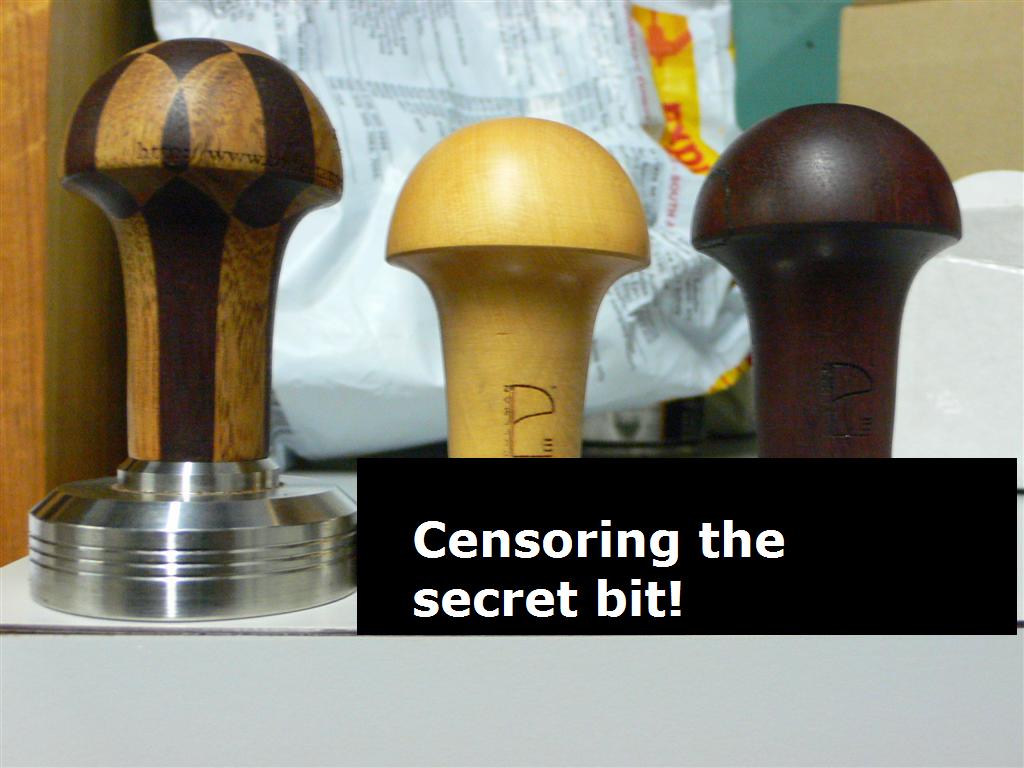
Yep, good ole Greg Pullman is at it again. One great thing about Greg is that he listens to feedback, even when it hurts. A few years ago, Greg's tampers had ridiculously long handles and the base was just a flat stainless steel circle. All of it was of the same quality that his tampers are today, but it was just plain irritating to use because of the long handle. So it was changed. I commented that I thought that levelling grooves around the edges would be cool. Greg didn't like the idea, but tried it out. Now, not only is it part of the tamper, it is part of the logo! Greg Kaan thought that a chamfered edge on the top of the tamper would be good. It was done. And, so, the evolution continues with some more test modifications ...


... but I have been asked to keep them secret!

Of course, Greg isn't the only one working on cool new toys. The boys at Veneziano are locked in a game of one-upmanship. On their stopover in Italy before the World Barista Champs, Pete and Dave took the opportunity to visit a few machine factories. Now, some manufacturers are brilliant - just tell them what you want, and they'll do it. Dave stopped by Maver and talked to them about their Marte model. A dozen of them landed a few months ago, and Dave has been tweaking them ever since. The big modification was to the thermosyphon, so that the group actually delivers the temperature that you want, with the minimum dicking around. It worked damned well and, out of the box, the machine seemed to almost require no cooling flush to get decent espresso out of it! Preinfusion time was great, not like the ridiculously long wait with the Expobars and the shots didn't speed up and gush as much as they seem to on a giotto (although that probably has a lot to do with the coffee that I have used on them and the baskets that they had in them). The angled pf handle was a nice touch. Anyhoo, Dave asked me to keep my trap shut until he had played around with other restrictors, steam tips, etc. Well, given that he is selling them on Ebay, and that Mark from St Ali has already sold one, I presume that the cat is out of the bag. At some stage, I'll have to jones for a more in-depth trial than four or five shots.

So Dave was the big man around the roastery for a month or so until Pete landed a bunch of custom-made machines, by BFC, just last week. BFC made the very clever move of doing their own body kits, which means that a lot of people just get the same decent machine, with a different body. The 'La Valentina,' 'Junior' and 'Diadema' home machines are good examples. So it was with much enjoyment that the techs at BFC put a different machine, with specifc internal requirements, into the standard body for Pete. The machine really is a 'roaster's machine,' with some clever features like easily-accessible pressurestat and some other stuff that I might not be able to mention. The drip tray is forehead-slappingly simple and clever, though!

The funny thing is that, Pete's machine, too, is cruising to be overshadowed. Naturally, no stopover in Florence is complete without a visit to the La Marzocco factory, with its gorgeous break room. Who doesn't love a custom-hotrodded FB-80 overlooking the tuscan countryside?


No, that's not me. Unfortunately my LM factory photos were on my old computer
when reformatted. I'll have to get them back from the backup CDs, if we still have
them. The above photo is of Mark Prince and Andrew Barnett (?), and is part of
Mark's awesome La Marzocco factory visit gallery on flickr.


LM have a great strategy. Welcome all of your visitors. Take them up to this break room. Let them play around on awesome machines. Make sure they drink great espresso, gazing over the tuscan hillside ... so, of course, Pete and Dave had to order a custom FB-80. The huge semiauto buttons with the lion on them light up when you engage them to brew and there are custom spotlights next to each group! It's on the boat now. Here are some shots that LM snapped, before sending it off. Blurry, in true tabloid journalism style :P


Cool new stuff doesn't stop there. Sunbeam apparently have a new version of their EM6900, 'Paul Bassett' machine coming out soon. Jeffrey from Pallo and Steve from Coffeelab Design are also not resting on their respective laurels and my boss Andrew is coming up with a custom blend for Maling Room.

Teeeheehee ... it's good fun to blurt out everyone's 'secrets' every now and then. Maybe I should go and work for women's weekly ...

Labels: