Saturday, November 01, 2008

LucaTech Industries Unveils the GhettoMax 2000 and Filter Coffee in Australia

Enter Mr Callahan

A few months ago, Adelaide espresso savant Ian Callahan threw down the challenge during conversation:

So here are the rules. Who can find the best/funniest/cheapest/most ingenious piece or pieces of crap to either
A) Chuck Norris (read, brake beat or crush) or
B) McGuyver (read, manipulate or engineer in some way) into a Drip station.

Single drip is okay, bonus points awarded for multiple cup drip/pour-over station, as well as practicality or sheer impracticality.

I feel that we need to set important boundary on the competition - you have until, say, December 14 to enter and you may enter as many times as you wish. (Selected so that my exams will be out of the way and I can have another go.) Your entry must disclose everything necessary to make your pourover station in such a way as to spoil the prior art base for anyone who might wish to patent such a device in future ;P Once all entries have been rounded up, Ian will collate them into a post on his blog and we can vote for a winner, to whom Ian will forward a prize by Xmas ;P

Given that Ian has a blackberry, I expect that he will be aware of what he has signed up for slightly before I publish this blog entry.

What the heck-a-roo?

So, if you're not up to speed on the uber-glamorous world of professional pourover brew stations, you might want to check them out:

4 Cup Station truBru from Taylor Maid Farms - $330 USD

4 Cup Station from the genius tinkerers at Espresso Parts $595

The latest Cafe Culture also features a 4 cup station called the 'terror bar' from Factor Design. Looked expensive - does anyone have a price?

The LucaTech Industries GhettoMax 2000 2 Cup Pourover Filter Station (EXXXTREEEEME)


As you can plainly see, the GhettoMax 2000 has a number of features unparalleled by any filter station on the market:
*Portability (TM) - suitable for catering, you can take the action to your customer and you can save valuable bench space when not in use.
*BrewGuard (TM) technology - owing to the wire guard on the side opposite the brewer, customers cannot touch the streams of filter brewing coffee
*Adjustulon (TM) saucer stands to get the brew vessels at the height of your choice
*PrecizoSize (TM) - the entire modular unit can be washed in a standard commercial dishwasher
*IKEA friendly (TM) - by utilising componentry from IKEA, this station will naturally blend in with the decor of any cafe ... that also uses a lot of stuff from IKEA

And the total cost is ... drumroll ... $5 per unit for the GORM clip on basket and you probably have everything else lying around anyway. To assemble, just buy one of the cheapass baskets, pull out the tin snips and make the necessary bends and cuts to get this:


OK, so it's a total piece of crap. But at least it's a cheap piece of crap.

Part II: Filter Coffee in Australia


Compared with the rest of the world, Australia is truly upside-down when it comes to coffee. We are close to unique in having a retail brewed coffee market that is almost 100% espresso. Until recently, that 'almost' was the nasty drip brewers at McDonalds. You know, the ones where the coffee would sit in glass carafes, baking on a hotplate for days because no Australian would actually buy it? The irony is that standard coffee scoring systems rate coffee for use as brewed coffee. Many is the time that I have had an 80something pointer outperform a 90+ coffee on the espresso machine. That said, brewed coffee is a fantastic way to appreciate the best that the world has to offer. The USA and Japan seem to buy a lot of the world's top coffee for consumption as brewed coffee. We could do worse than develop a fantastic brewed coffee culture in Australia to sit alongside espresso.

Enter the Clover. A few years ago, no-one in Australia had the slightest inkling of interest in brewed coffee aside from roasters, ex-pat yanks and random nutcases. A few brave cool kids bought a machine that produced coffee with a similar taste profile and - bam - people start to show some interest. Never mind the control that it gives you over the brew; people seemed to be more interested in the price tag and the fact that it was a complicated machine more like an espresso machine. Interest continued to gather for a few years and some of the cool kids overseas praised it to high heaven and built up the buzz. It looked like we were at a tipping point.

Out of the blue, checkmate - Starbucks bought the whole friggin' company, patents, kudos and all! A very clever move on their part. Starbucks has phenomenal buying power and reports are that they have been starting to snaffle up a lot of lots that specialty coffee roasters would otherwise like to buy. Is it possible that we could start seeing great coffee coming out of Starbucks? I can't see Clovers being rolled out in Australia for quite some time, if ever. It looks like Starbucks are doing OK, but not brilliantly with their Clovers overseas, with part of the problem being an inappropriate roast level. Still, it's only a matter of time until they get it right ...

Meanwhile, the snapping up of the Clover by Starbucks makes it unavailable to specialty roasters and cafes who might be interested in it. A similar level of control is offered by siphon brewers, but they are a total PITA to clean. You would have to be nuts to try to use one in a cafe ... how do the Japanese do it? Commercial filter brewing machines can produce a great result, but brewing two litres at once probably won't go down well with a public where those that are interested in coffee expect it to be brewed on demand and those that are not won't order it. French press/plunger is gritty and hard to clean. Aeropress doesn't have the clarity of flavour of filter. So, funnily enough, we are left with a renewed interest in single cup, pourover filter brewers - originally laughed out of the room as an alternative to clover. And why not? It's easy. Wet the filter paper, grind coffee, pour over water at the right temperature, serve up the brew and dump the leftovers in the bin. The amazing thing is that pourover filters actually do a much better job of brewing at a decent temperature than some crappy filter machines.

With a nice article in this issue of Cafe Culture, it looks like Toby is trying to take up the charge for pourover filter in Australia. Frankly, I was surprised. I have always pigeon-holed Toby into the high brew ratio, slow dripping, gloopy, chocolatey ristretto camp. After all, legend goes that Toby was critical in helping PB to develop the high brew ratio technique known as 'updosing', which has become as intertwined with the Australian identity in international coffee circles. Everything that I have tasted from Toby's Estate has been consistent with this approach and the TE stores seem to be kitted out with equipment geared towards it. This style of coffee is about as far from the light brewed cup as you can possibly get. Well, in recent years PB has been experimenting with 'downdosing', so maybe this is Toby's equivalent? Maybe Toby's interest simply arises from the similarity between filter brews and the cupping that all roasters enjoy? I'm looking forward to Toby's session on filter coffee as part of the Golden Bean and will endeavour to find out the answers - if I remember!

Labels: , ,

Thursday, August 28, 2008

The Emerald in the Coffeebloggosphere's Crown, or not so Special?

Eliminating The Suspense

Esmeralda = emerald in Spanish, OK?

The Esmeralda That Was


Esmeralda is one of the coffees widely regarded as one of the world's best; its reputation is that of a modern-day Jamaican Blue Mountain. Last year, my curiosity got the better of me and I arranged to procure some from Paradise Roasters. In blogging about it, I introduced it as follows:

I probably don't need to write too much about this one. If you have been living under a rock, or if you just happen to be one of the few people who doesn't follow the coffee auctions, you might not know that this is currently the world's most expensive coffee. Previously, that dubious honour went to kopi luwak. (I'll spare you the jokes - google it if it's news to you.)

Esmeralda has an impressive back story; in a nutshell, the gesha varietal that makes up the Esmeralda Especial lot seems to have basically gone extinct except for a few random rediscoveries in Panama. It just so happens that this particular farm's gesha offering has won something like four Best of Panama auctions and every single other cupping competition it has been entered in. In terms of scores, the consensus seems to be that it's a 92 at a minimum, with some tasters going as high as 97!

The 2007 Paradise Roasters lot displayed a predominant and intense mandarin flavour in all brewing methods, backed with hints of bergamot and a slight astringency.

The Esmeralda That Is

Last year's, as far as I can tell, the correct name for it was "Hacienda Esmeralda Special." Flash forward a year and all of a sudden, the Petersons decided to shake things up by sorting the crop into different lots, all of which were auctioned under the "Hacienda Esmeralda Special" moniker. Again, the auction was blogged about widely. Readers are encouraged to post links to other relevant posts in the comments field. If you have to choose only one (other) blog post to read on the subject, remember the old saying - "in Hoff we trust." James' points about dilution of their own trademark and the effect on the market struck a chord with me, particularly seeing as trade marks was one of my favourite subjects.

The auction itself always reads like a who's who, so you might like to imagine Joan Rivers delivering the commentary. Stumptown was wearing batch one, hailing from "north of the creek," but the heavy hitter shared the most expensive batch, two, with Sweet Maria's. The dashing duo deftly devoured batch three, the peaberries, whilst 49th snapped up the sole double pass lot. Though the Petersons didn't credit Mountain Top for their technique - as I understand it - one wonders if the Piccolo clan's decision to purchase wasn't influenced by best buddy, Australian Mountaintopophile and coffee guru, Instaurator, who has done some consulting for them. Batches six through ten were bought by a wide spectrum. For the readers of this blog who I know follow the Japanese CoE buying circuit, it looks like crowd favourite Kentaro Maruyama didn't even contest the Esmeralda auction against big dog Wataru Nishibayashi. Presumably this means that Wataru will edge ahead of Maruyama in the awesome coffee purchasing league tables, but I would still want a several Watarus for my mint condition Maruyama trading card.

Competition results also deserve a mention. This year, the Petersons gave the Best of Panama competition a miss, presumably in order to give someone else a chance at winning. They also failed to place first for the fourth time in a row at the SCAA cupping pavillion (perhaps one of my kind readers could provide the link; I can't seem to find it). Fortunately, though, they did at least manage to walk away with first place in the rain forest alliance cupping for quality competition.

Anyhoo, that's enough background.

Having had spectacular success with the Mamuto, I decided to place an order for Esmeralda with Terroir, along with a few other goodies for various people:


Nim's care package; two packs of Esmeralda, a pack of Mamuto, Coffee Trail book, Hacienda La Minita book and a pack of the AWESOME filtropa pourover filters to go with his filter cone.

Let's take a closer look at that label ...


Where's the trademark Howell photo?


It was interesting to note that last year's batch from Paradise was comprised of unusually long and thin beans. This year's lot from Terroir looked considerably shorter and rounder ... perhaps a consequence of the decision to separate Esmeralda Special into different lots.

Anyhoo ...

Siphon/Vac Pot/Clover: These brews varied from being excellent to OK and I found the coffee difficult to work with. Several tasters agreed that there were Earl Grey tea (bergamot) notes, but differed to the intensity that they perceived. Sweetness was not as high as I had hoped, there was a good measure of acidity and the coffee was dry. The best brews had hints of peach.

Espresso: As I felt that the coffee was slightly too dark for siphon, I took it into the big V, borrowed one of their grinders and treated everyone to some Esmeralda espresso. The espresso had the kind of astringency that I usually associate with a roast that is slightly too light for espresso, but displayed a tiny amount of sweetness and some tannic tea type flavours.

This lot was interesting, but not the mind-blowing experience of last year's lot. Differences could have been due to (a) the separation of the Esmeralda Special lots this year, (b) the roasting of the coffee and (c) the shipping of this coffee, and attendant two week delay from roasting, compared with the last lot being brought over in carry on luggage. It would be very interesting to try out the various lots from the various sources that bought them, but that would probably end up being an expense to rival Krusty the clown's addiction to faberge' eggs.

The Esmeralda that will be ...?

It will be interesting to see if anyone actually does the work of tasting all of the various Esmeralda lots and working out how big the spread in quality is. Who knows how Esmeralda Special will be divided up in future? I am also very interested to find out how 49th's lot will go and whether this processing method might take off in Panama.

Digression - Siphon - Again


Siphon continues to be a learning experience, though brews are usually pretty good nowadays. I thought that the butane burner warranted a quick post. Frankly, I can't see how you can really use a siphon without putting it on the stove or using a butane burner. I bought mine off ebay from Jack Grieve. A similar burner is available at a very reasonable price through Jack's web store, along with some pretty cheap siphons.

When used in conjunction with a thermocouple, the butane burner makes it possible to get repeatable and adjustable brew temperatures. A marathon session of three siphon brews (and three cleaning runs) showed that the burner seems to emit more heat immediately after it is filled with gas. Good practice would be for the first use after refilling to be in a cleaning run.

So far, adjustments to the water temperature, dose and grind for the siphon have had eerily similar effects to doing the same thing for espresso.

One final tip - remember that every siphon brew is diluted by the water that doesn't make it into the top chamber to start off with and, as this is a fixed amount, the proportion of each brew that is made up of water that has never been in contact with coffee will increase if you try to brew less than the maximum amount for any given siphon. This lead to the experiment and realisation that if the brew is slightly on the strong side, dilution with hot water can sometimes save it.

Labels: , , , ,

Sunday, August 17, 2008

Minita and Mamuto Mumblings

Introduction

I'm a firm believer that the quest for coffee excellence requires tasting a lot of different coffees with an open mind. For my purposes, I try to taste a lot of different stuff purely to build up my own palate, as well as to get an idea of what others are writing about and what is possible in the world of specialty coffee. All of the good roasters that I know also believe in tasting a lot of different coffees - they view it as an exercise in benchmarking, without which they will quickly be proclaiming the virtues of utter crap; emperors with no clothes. Conversely, I don't think it's a coincidence that the very few roasters who I have heard of who don't taste widely do not produce a good product. (That applies equally to home roasters as it does to commercial roasters.)

The USA

Several years ago, I never would have imagined ordering coffee from the US of A. Over the past few years, coffee from the US has made regular, but infrequent, inroads into my usual rotation - fuelled in part by the prolific writings of the US bloggosphere and other coffee web pages.

It would not surprise me if the USA's coffee mainly does live up to the stereotypical Starbucks ashy espresso or the pot of drip coffee that has been sitting on the burner for a week, but they have a lot of good things going for them. As the world's largest economy, they have considerable buying power and they are conveniently placed near south and central america; two great producing regions. Their roasters appear to have developed against a background of a drip coffee culture, in which single origins are appreciated for their unique characteristics ... even if only because of the forehead-slappingly obvious contrast between a smooth colombian and a winey kenyan. In comparison with Australia, their espresso roasts have developed in the vacuum of Starbucks' shadow. Finally, they have an active specialty coffee association and are home to various programs such as the cup of excellence and the coffee quality institute. The USA has well and truly emerged as a big player in both the worlds of espresso and brewed coffee - one that leads the charge in many respects.


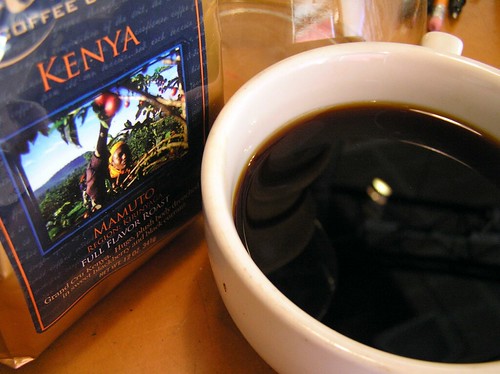
(Unfortunately, I appear to have misplaced my bag of Mamuto. I have taken a page from the book of barismo and borrowed this photo from Steve Ford. Steve ran an excellent project where he took a photo of the first cup of coffee that he drank each day over a year. You can check out 'First Cup' here.)

Terroir and George Howell

This particular coffee comes from Terroir in Massachussets. Terroir is run by George Howell, the man who founded the multi-site roastery 'Coffee Connection,' which he later sold to Starbucks before co-founding the Cup of Excellence and winning the SCAA's lifetime achievement award. Avid PQ readers will note that this is not the first time that Howell has rated a mention on this blog and I reiterate that his Long Road To Coffee Quality is a must-read.

The lovely thing about the prevalence of e-commerce in the USA is that the person on the other side of the web site is usually quite responsive and adept at getting around all sorts of problems, which included the difficulty of getting the coffee sent out as soon as it was roasted and correcting for an incorrect credit card number on my part. Nonetheless, postage is still a significant problem, with my package taking about three weeks to get here. Ugh. This activity is also not for the faint of wallet.

Costa Rica La Minita

La Minita has a reputation of being one of the great coffees of the world. It is also a model of quality and ethics working hand in hand. In a nutshell, my understanding is that they are very stringent on their picking and processing, to the point where they pay the pickers a premium to ensure that under-ripe fruit is not harvested. In turn, this means that their product is consistently good, justifying the premium for the roaster. This is a delicate, washed coffee that is really ideal for brewed coffee (drip/filter/siphon/clover). However, I first tasted this coffee in Klaus Thomsen's 2006 WBC winning blend, where it was paired with Daterra Sweet Collection to create a light, clean, crisp and sweet blend.

Siphon/Drip: Bright, slight apple flavour. Slight bitterness emerged on cooling.

This particular coffee simply didn't stand up to the battering that it received in shipping. I have no doubt that it would be better if it were fresher. That said, it wasn't exactly bad, but this struck me as a relatively subtle coffee that was always bound to be overshadowed by the Kenyan powerhouse. Read on.

Kenya Mamuto

The Mamuto has gained notoriety due, in part, to the ridiculously high scores that Kenneth Davids has awarded it over the years. Again, this coffee also demonstrates that quality and ethics can happily coexist at the pointy end of the market - when I bought it, Terroir's web page said that $2USD per 12oz went back to the farm, which is a helluva lot of cash in the world of green coffee.

Siphon/Drip: Bright, sweet, smooth, ribena, coffee cherry, tomato.

This coffee was simply fantastic. I turned off the espresso machine for a week and gladly scrubbed my siphon out. If it was that good after its shipping ordeal, it's kind of scary to imagine what it would have been like earlier. Simon James was of a similar opinion:
Well I’ll cut to the chase! The Kenyan Mamuto was STELLAR! No wonder it scored a 97 at Coffee Review. I can’t say that my description of the flavours I experienced was the same as those of the Coffee Review, but it was certainly sweetly powerful, with a smooth balanced finish. But I got blackcurrant aroma with stewed apricot in the cup. A very tasty coffee!
Needless to say that this coffee stood up to its trip a lot better than the Minita did. I actually took both the Minita and the Mamuto along to a cupping at BBB. The Minita fared well, but was not a standout. The Mamuto was the absolute stand out; it was everyone's pick, regardless of their level of experience.

From my description above, you can see that this cupped up like an exceptional, but classic, Kenyan coffee - very different to what one would expect from a Colombian, for example. It's worth pausing to reflect that perhaps it is the fact that these coffees tend to have the least 'classic' profile that makes them so clearly special. Coffeecuppers deal with the distinction between classic cups and unusual coffees in their short coffee tasting primer. Howell that this consistent and unusual cup profile merited the title 'Grand Cru' - on his fondness for wine analogies, see CG podcast 63 (link directly to 29 megabyte mp3 file).

Teaser

Yeah. I admit it. I have some different stuff on the way from Terroir - readers with less respect for their wallets are invited to taste vicariously through future posts. I'm also keen on getting some stuff from the outstanding Ecco Caffe if anyone wants to split postage at some stage.

Labels: , , ,

Monday, April 21, 2008

A Five Star Coffee: Guatamalan Cinco Estrellas

Introduction

I'm happy to go out on a limb and presume that Spanish is the main language spoken in Guatemala. (Go ahead; wikipedia it up and tell me I'm wrong.) This being the case, "cinco estrellas" means nothing more than five stars. Whether this is a grading or a trade name, I don't know.

The terrifically uninformative start to the post is really just to draw attention to the nature of the coffee trade in Australia and to underscore the importance of cupping as a commercial roaster; how much do we really know about the green that is on offer? I would argue that we don't know much, in stark contrast with some of the top-end roasters overseas, who can give you full details of the family trees from which their farmers pluck both their coffee and their workers. Fortunately, the depth of the brew in the cup doesn't depend on the length of the name on the bag ... it just means that roasters have to be shrewder about their purchasing decisions.

The Cinco Estrellas draws together a few different lines of research that have kept me amused of late and over the past few years. The first line of research concerns role of the washed coffee. My much-neglected regular readers will probably remember my linking to this thought provoking piece on the subject. It so happens that this coffee is a washed coffee. In fact, it more than so happens ... according to Edwin, it might even be illegal to sell naturals in Guate. Washed coffees tend to produce a clean, bright cup, perhaps with some subtle flavour accents and/or sweetness. See coffeeresearch.org In fact, I'm sure that many people would think of washed coffees as one-dimensional when it comes to espresso. This last trait made the 5* an excellent feed into the second and third lines of research; learning how to use my gene cafe and learning how to brew drip.

On Drip Brewing Generally ...

The humble drip brewer seems to be becoming a bit sexier. The revolting idea of the day old carafe sitting on the hotplate at McDonalds has long since left my mind and been replaced with a willingness to actually give it a shot ... admittedly brought on, at least in part, by involvement in the cupping comps. (Including my atrocious 5/8 score in the last one.) It turns out that there is more than meets the eye to drip coffee equipment - for example, the k-mart drip brewer at work definitely brews a less flavoursome cup than the old royal boiler co thing that we found. As far as I can tell, the much-lauded Technivorms aren't available in Australia ... a fact that I regretted until I realised that even I have no use for a litre of drip coffee.

For $20, I was game to find out how the humble plastic pour-over and melitta filter fared. This brew method carries the weighty approval of Paul at Mecca, so I figured that it couldn't be that bad. It turns out that if you pour water straight off the boil, the brew stays between about 95C and 92C for the whole brew time. (That sound you're hearing is of a million k-mart brewer owners slapping their foreheads.) Anyhoo, 15g of ground coffee and 250mL of water right off the boil seems to yield a tasty cup in something like a minute. Comments welcome.

The cup profile is very clean; totally sediment-free because of the paper filter. The cup changes a fair bit as it cools; at the beginning it is too hot to taste anything, then you hit the optimum temperature to get a flavour explosion, then it cools down and all that you can taste is brown and acid. It's kind of like Clover ... although that statement seems to be pretty cool since the big green mermaid plucked the little green plant.

Drip Tasting Notes

Over the first few days, the 5* simply tasted ashy and quite acidic. Surprisingly, letting it sit for a week improved it immensely - something that I expect for espresso, but not for anything else. After a week, the cup was clean, relatively acidic and had an interesting potpourri-like character that I can't quite put my finger on. I was quite surprised to see that subtlety emerge after a week, as opposed to retreating.

Espresso

The roast must have been quite close to second crack, so I decided to give it a shot through the Maver. The resultant espresso was quite bright, very sweet and very clean. It actually reminded me quite a bit of Klaus Thomsen's WBC winning blend. It did an admirable job in milk, with little body to speak of, but a fair bit of caramel. I only wish that I had left myself enough to experiment with lowering the dose.

# Update 27 April 2008 #

I found myself with a little 5* left over from the last roast and decided to experiment with a lower dose, as I alluded to in this post. It turned out to be a good call. The resultant espresso was a bit less sweet this time around, but it presented a fantastically balanced shot, with the elusive floral/potpourri flavour from the drip brewed shots making it through into the cup. The shot was light in body, but otherwise exceptionally rounded and complete. Perhaps the most interesting feature was a distinct bitterness that was not at all unpleasant.

Labels: ,